Alibris Hard to Find Books Standard

Saturday, November 14, 2009

You can take gold out of the standard, but you can't take the standard out of gold

In the latest Buttonwood post at the Economist entitled "Paper promises, golden hordes," the writer notes that gold is coming back into vogue. The price has tripled over the last six years, says another researcher, David Ranson of Wainwright Economics.

It looks like the public has decided that paper money isn't so attractive at this conjuncture, and even some central banks are thinking along those lines, to wit Russia, China, and India.

All this makes perfect sense. Gold is not only a store of value; it's a barometer for currencies.

goldbarometer

This flies in the face of a recent paper by Barry Eichengreen and Douglas Irwin, cited in the Buttonwood post. These two economists have come to the conclusion that "[d]ropping gold did work" i.e. that abandoning the gold standard has somehow shortened recessions and reduced the inclination to raise as many tariffs.

Other economists would disagree. They hold that, in fact, dropping the gold standard and instituting a process of monetary expansion through a central bank is what caused the distortions in the economy in the first place, which in turn led to the recessions and even the Great Depression itself.

I particularly love this statement: "When countries on the gold standard suffered a shock [my italics] they had to let the real economy, rather than their currencies, take the strain." Countries don't just "suffer a shock." Distortions in the economy cause shocks. And according to some economists, central bank responsibility is involved in every recession and depression since the Fed's creation. Like SUVs, economies don't just drive off the road.

We may never find ourselves back on a gold standard as that institution was understood in 1900; however, I believe the world is on a de facto gold standard, by the very nature of this unique metal. Push will come to shove soon, as the Buttonwood post explains:

"[F]oreign creditors have a right to be more suspicious of debtor countries. Even if they do not resort to outright default, they can always achieve partial default through currency depreciation.

"Indeed, the law of volatility can be invoked again. Developed-country governments have attempted to control bond yields through quantitative easing and to support stock markets through ultra-low interest rates. But they cannot support their currencies as well without risking problems in the bond and equity markets. Gold's surge may indicate that investors fear the next stage of the crisis will occur in the foreign-exchange markets."

You can bet your bottom dollar on that one. And with jawboning for China to reevaluate its currency (watch out what you wish for), Australia hiking its interest rates (twice already), and the dollar reaching new lows (how low can it go?), gold will start to look better than ever.

Labels: , , ,


Sunday, October 04, 2009

Are Markets Efficient?

There are investment advisors who claim that their clients should not worry about investing in the stock market because markets are inherently efficient, or rational. Are they efficient? That depends upon your definition of the word "efficient." Are they rational? That depends on your definition of "rational."

car
[Thanks to Hamiltoncountyfirefighters.com for the photo.]

I have pointed out previously that vocabulary is important, all the more so in any discussion of scientific subjects. Here are some definitions taken from Merriam-Webster:

Efficient:

1. being or involving the immediate agent in producing an effect
2. productive of desired effects; especially: productive without waste

Markets are efficient-No.1 in the sense that they produce an immediate effect. Are they efficient-No.2? Do they produce desired effects, or productive, unwasteful effects? That is the question.

If you are advising an investor to believe in markets because they are efficient, are you stating that they are efficient-No.1 or efficient-No.2? Isn't it possible that markets are efficient-No.1 but that they are not efficient-No.2, because they produce unproductive and wasteful side effects? And isn't it possible that one of the victims of those side effects is your client?

Rational:

1.b. relating to, based on, or agreeable to reason

Reason

1.c. a sufficient ground of explanation or of logical defense

Reasonable

1.a. being in accordance with reason
1.b. not extreme or excessive
1.c. moderate, fair
1.d. inexpensive

Markets are rational in the sense that there is certainly a logical sequence of events behind every movement, and those movements may have a logical defense, even if we are unable to discern their every step. But are they "reasonable," in any other sense than 1.a.? Hardly.

Markets are a machine. They function with all the givens and with nothing else, like an automobile. In a true free market (perhaps impossible to achieve), one might assume that markets would hand out justice where justice is due over the medium to long run, maintaining the course in spite of some waste. However, in markets such as we have today, with lots of government entities fighting over the driver's seat of our automobile, the result is a bunch of vehicles that can veer all over the road and hit a tree or each other in a most to-be-expected rational way but resulting in wasteful self-destruction.

Overseers of the markets cannot force them into productivity, efficiency, or fairness. I believe there is partial validity in the statement by certain economic theorists that all markets are efficient-No.1, and rational as explained above; but from there to assume, as certain investment advisors have done, that we should invest as though government had no destructive effect on markets, is a travesty.

Labels: ,


Wednesday, September 09, 2009

The More Things Change ...

Gold has just hit $1,000 and seems to be staying there. China has revealed that it is divesting its dollar holdings into gold and other assets in order to save their sovereign-fund investments. Even the UN is getting into the act. (Do they see a future role for themselves?)

Stonehenge
[Thanks to Wikipedia/commons for the photo.]

The more things change, the more they stay the same. So this seems as good a time as any to recall what was said by a subsidiary of the American Institute for Economic Research back in July of 1975 when the Institute's founder, E.C. Harwood, was still alive. Much of it is still relevant today.


"Removal of the gold reserve requirement for Federal Reserve notes (your paper money) in March 1968 and closing of the so-called gold window in August 1971 eliminated the last barriers to inflating continually the Nation’s purchasing media. As long as a substantial gold reserve was required by law, the money-credit managers were confronted with a restraining influence.

Now, only the wisdom and determination of the Nation’s money-credit managers can prevent the ultimate decline of the buying power of the dollar until it becomes nearly worthless. To what extent the citizens can rely on the wisdom and courage of those 'responsible men' can be judged by events of the past [seven] decades, including loss of 70 percent [how much today?] of the buying power of savings and life insurance, the increasing rate of depreciation in recent years, loss of much of the Nation’s gold, and the fact that several of these managers have been among the most persistent in advocating the removal of all restraints. Truly wise and responsible men would not want to be without the guidance of such an objective criterion as a gold reserve requirement; and unwise, irresponsible men should not be relied upon to act properly without such guidance.

The dollar appears doomed to continue losing buying power, the only question being, 'How long before it will be practically worthless?'

We, as well as others, have foreseen this possibility for many years. [Six] decades ago advising investors how to protect themselves against substantial depreciation of the dollar was relatively easy. Most domestic common stocks then were available at prices approximating the prewar level, and a long continued upward trend of windfall profits for U.S. corporations was practically assured by the World War II inflating.

Now, however, the situation is different. No longer is there a large reserve of idle purchasing media such as that accumulated during World War II, which was used to augment business expansion during the earlier postwar decades. Rather, there now exists a huge amount of debt incurred during the prolonged period of inflating. Debt liquidation may have a cumulative effect on business failures.

CONCLUSIONS

We have concluded:

1. … Recently Government authorities have been more concerned with attempting to avoid a severe depression than with reducing the rate of inflating.

2. That the various “welfare state” obligations, including the unfunded Social Security obligations, constitute a self-destruct mechanism reducing the standard of living, and consequently the birth rate as well, for a majority of the Nation’s population.

3. That prolonged past inflating has fostered initiation of innumerable businesses lacking adequate capital, widespread speculation “on margin” in real estate and securities, and installment borrowing on an unprecedented scale by individuals.

4. … Even if [there are] chances of a temporary recovery induced by deficit spending … the adverse possible consequences of a severe depression are so great that we do not recommend gambling on a near-future cyclical recovery.

5. Finally, that continuation of the international financial crisis justifies placing much of one’s funds abroad before exchange controls are ordered, which may occur at any time….

RUPTURE OF ECONOMIC RELATIONSHIPS IN WESTERN CIVILIZATION

The consequences of nearly four decades [make that seven in 2009] of almost continuous inflating are becoming more evident with each successive international monetary crisis. All currencies have been and are being degraded steadily. All now have lost about three-fourths, at least [nine-tenths as of 2009 for the U.S. dollar], of their pre-World War II buying power, and all seem destined to depreciate much more in the next several years, perhaps for as long as a few decades before they become practically worthless.

Clearly, what the world needs is a relatively stable money or accounting unit. In the absence of such a unit long-term promises including bonds, life insurance, and pension plans are like a mirage in the desert and business depreciation schedules are misleading distortions of alleged facts. Unfortunately, the world is getting a continuing flood of paper 'money' that has neither a reliable exchange value nor any assurance that it will retain future purchasing power. Without these two essential ingredients, confidence in fiat paper 'money' will continue to diminish, until the flight from currencies overwhelms the efforts of monetary and political authorities to cope with the chaos.

Politicians generally insist on remaining in their Politicians’ Paradise where lavish promises in order to obtain votes are fulfilled with inflationary purchasing media created to finance government deficits. Their accomplices in embezzling the savings and life insurance of the people in Western civilization are the central bankers of the leading nations. Without exception they choose to remain in their Banker’s Heaven, where promises to pay are, as John Exter pointed out, simply 'I owe you nothings.' And the people of Western civilization are beginning to endure the Hell that has been paved with the good intentions of those who would save the world (and incidentally retain power, or is it vice versa) by the money-credit manipulations.

We see little possibility that there will be a return to sound money-credit procedures until after some bitter lessons have been learned during a future depression.

Meanwhile, each succeeding crisis in the foreign-exchange markets for currencies will tend to spread the realization that paper profits are more easily reaped than retained, and that the purchasing power of hard won savings is ephemeral unless those savings are invested in a tangible asset whose exchange value is not subject to manipulation by the monetary and political authorities. Among such tangible assets, gold has proved throughout the centuries of history to be unsurpassed both as a unit of account and as a store of value. Therefore, projecting an increasing demand for gold in its various forms during the period of unstable monetary conditions that almost surely lies ahead appears to be warranted in the light of both recent experience and earlier history.

The more the politicians and central bankers struggle to free themselves from the so-called 'tyranny of gold,' the more that governments endeavor by controls of one kind or another to counteract or conceal the consequences of their money-credit follies, the more they endeavor to seize the wealth of citizens by increased taxes of all kinds in the hope of maintaining a semblance of monetary order, the greater is the incentive of the citizens of every country to get gold. As a safe and sure means of holding wealth, of avoiding the grasp of the tax collector, and of assuring the economic future of families, gold never has had a peer in the history of mankind. Those who would demonetize gold in order to facilitate their embezzlement of private wealth and maintain their positions of power in governments and central banks are following policies that must inevitably teach every intelligent citizen the usefulness of gold. The money-credit managers are defeating their own ends at a price that almost surely will include serious retrogression within Western civilization."


Aren't these remarks still valid today? I'll just leave you with my mantra:

You can take gold out of the standard, but you can't take the standard out of gold.

Labels: , , , ,


Friday, August 14, 2009

Interview with William Black re fraud in financial services

Just a short post today to point you to an interesting interview of William Black at American Institute for Economic Research on the topic of fraud in the financial services industry. He discusses techniques for prosecuting fraud and also the characteristics of your typical fraudster, including Madoff and how the SEC missed him.

Interview with William Black is linked at AIER.

Labels: , , ,


Sunday, August 02, 2009

Hyperinflation Not an Option, Say Some

Friday I attended a Symposium on hyperinflation at the American Institute for Economic Research. Participants were Thomas Glaessner of ICG at Citigroup, Peter Heller of the International Monetary Fund, Gerard Caprio, Professor of Economics at Williams College, and Joshua Rosner of Graham Fisher & Co.

zdollars
[Thanks to Virginmedia.com for the image of Zimbabwe's 100-trillion dollar notes.]

Glaessner had much experience with the hyperinflations of Brazil and Argentina; Heller did also but from the angle of the IMF. Rosner gave his own analysis, and Caprio served as moderator.

Glaessner and Heller both felt that hyperinflation was only a remote possibility due to the strength of various factors within the U.S. They both expect inflation at some point, but think that the Fed will somehow pull it off. Glaessner pointed out that the EU was in no better shape, in fact was worse off, and that the euro was not a real competitor to the dollar.
Rosner was more pessimistic in that he felt the Fed had lost some credibility and that the underlying problems that got us where we are today have not yet been addressed. He had predicted our current trouble well before it began, but no one would take him seriously. He now expects another strong deflationary downturn before things get better but also thinks inflation is a distinct possibility once the next downward swing has had a chance to run itself out. After questioning, he did agree that there existed a possibility that there might be a flight from the dollar. They all agreed that China might just find another medium of exchange with some of its trading partners.
Rosner pointed out that the securitization market had become the principal avenue of financing over the last dozen or so years, and he thinks that the recovery will depend upon the revival of this market, because the banks must accumulate capital and are not in a position to take back that function. They all agreed that the reforms of the OTC marketplace will be helpful if they are done correctly (and useless if done incorrectly), and the major OTC market participants are very active currently in trying to see that it is done well.

Gold was only mentioned in passing and time ran out before I could bring it up, which is a pity. I'd have liked to ask whether they thought there might be some more action. In my view, this deflationary cycle is the result of the previous inflationary cycle, and trying to buck the trend to preserve the price level is not going to solve the problem, but in fact make it worse. Judging from past idiotic government attempts to do so, such frontal conflict with deflationary momentum always ends in distortions, and I don't see why this time will be any different.

What does this mean? It means that the deflation will continue until the market finds its sea legs again, but because the underlying problem hasn't been solved, the market will not get those legs until the toxic cancer has been cut out and the financing channels are reestablished. When that will be is anyone's guess.

Meantime, government meddling with interest rates, the dollar, spending, and credit will backfire as usual. The interesting part will be to observe what happens this time. The country and the world might just not accept another inflationary spiral as they did in the 1950s, the 1960s, the 1970s, the 1990s, and the 2000s. Then again, I suppose there is a chance they will.

Rosner argued that there were too many debtors in the country who would all be quite happy with inflating their debt away. But I argue that this only works when wages rise, and I don't think businesses will let wages rise this time, all the more because unemployment doesn't look like it'll moderate any time soon and it'll be an employers' market (except on Wall Street). Non-banking business is getting too savvy about inflation. Rather than pass through any profits to labor, the extra cash will flow back to speculating (as it has already started to do), and we'll get even more disequilibrium between Main Street and Wall Street. (Seen those bonuses?)

We are in a 1929 situation with 2009 tools and a 2009 government mindset, but also with a 2009 public and business mindset. Whatever we get, whether it be deflation, inflation, or a mix of the two with or without hyperinflation, this is going to be interesting.

Labels: , , , , , ,


Tuesday, July 21, 2009

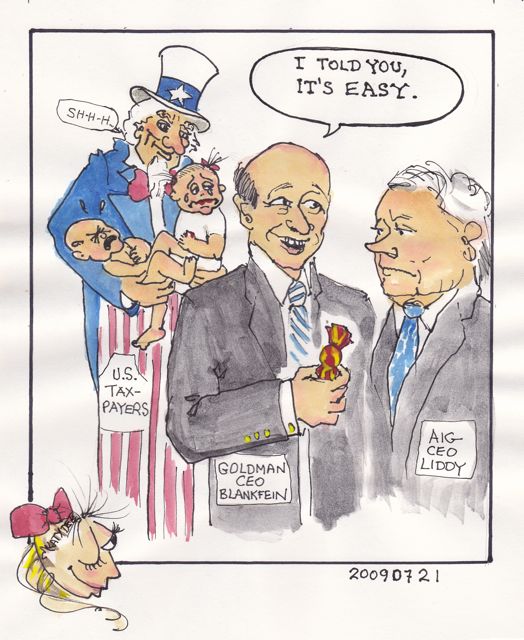
Bonus Bubble! Thanks to our Government's Intervention

You have no doubt seen the news. Goldman Sachs and AIG are paying out bonuses bigger than even at the height of the boom. There is too much competition out there to pay any less, they say. This may be true or it may not, but what is certain is that just about every big Wall Street investment house should be busted right now, which would have thrown thousands of well-paid financial wizards out into the street. If things had gone the way things should have gone without government intervention, there would be so much competition for Wall Street jobs that the remaining few employers could get away with paying one-tenth, maybe, of what they're paying today thanks to us taxpayers.

So I can't resist expressing my frustration.

[Click on the image for a larger version.]


And don't bother commenting that without government intervention we'd all be out in the street. I don't buy that argument, although I admit no one can prove what Might Have Been. (We didn't die after Lehman, did we? We could have declared a bank holiday for a week, gotten the crap off the balance sheets, and moved forward with a healthy but skinnier bottom line--maybe.)

PS: Apology to Messrs. Blankfein and Liddy: I do not incriminate you in this sad story. You, Messieurs, are only doing what comes naturally, i.e. what wolves do. They devour. I do, however, accuse the people who run around in the red-white-and-blue costumes calling themselves "Uncle Sam" and "Auntie Samantha." They are the sneaky wolves in sheep's clothing, the ones who say to us, "Let us fix all that ails you. Everything's going to be okay." And we're so dumb we fall for it.

Not funny.

Labels:


Sunday, July 12, 2009

Time to Throw Out the Efficient Markets Theory

Over the last few months, I've not been surprised to read that recent events have thrown a bit of doubt on the Efficient Markets [EM] theory. As defined in an article this weekend in the Financial Times, EM is "the theory ... that market participants are governed by rational expectations and markets are self-correcting."

smash
[Thanks to Greenwichroundup.blogspot.com for the image.]

If I understand this theory correctly, the correlation in practicality is that the most prudent long-term investment portfolio for the modest, ordinary investor, i.e. the one with the best risk-security ratio, would be something with a lot of Dow-type common stocks, because the collective markets take all factors into account quicker than any individual can do it.

The evidence behind this theory was provided, in part, by Jeremy Siegel of the Wharton School at the University of Pennsylvania in 1994, in a book entitled Stocks for the Long Run. Siegel analyzed data going back to 1802. According to another article this weekend in the Wall Street Journal, he based his statistics on data provided by two other economists, Walter Buckingham Smith and Arthur Harrison Cole.

However, the WSJ article points out two problems with Siegel's argument: (1) the stock samples chosen were "cherry-picked" and not "comprehensive," and (2) as of June of this year "U.S. stocks have underperformed long-term Treasury bonds for the past five, 10, 15, 20 and 25 years."

Oops.

Ever heard Benjamin Disraeli's phrase, "There are three kinds of lies: lies, damned lies, and statistics"?

I've always had a suspicion about the EM theory. It just seems too pat, too profitable to the Wall Street types, and not really adapted to the little guy: the forgotten men and women who just want to hold onto their hard-earned savings and gain a little real income from them.

I observe that Wall Street market players are not long-term thinkers who spend even a nanosecond worrying about the future of Western Civilization. They're the ultimate Instant-Gratification Kids, worried only about their next buck. "To hell with tomorrow," or such esoteric concepts as the "Forgotten Man."

Even more so today, as we slide into this second phase of our current recession, we realize that the Efficient Markets Theory--and even its supposed alternate, the "Treasury Bond Theory" (I'm inventing the name)--may both have failed us. This will be especially true if inflation hits us, as some predict (and I believe it will, when it comes time to put the Federal Reserve and Treasury credit genies back into the bottle).
The truth of the matter is that there is no stasis. No theory works all the time. As we slide up, over, and down the recessional curve, the corresponding statistical charts will prove first one theory and then the other, depending on where you start and where you stop the x axis.

So where does that leave us?

I would be very interested in some research comparing three model portfolios since approximately 1900 (more precisely, a year in which the market can be considered to have been healthy and balanced): an Efficient Markets portfolio, a Treasury bonds portfolio, and a Gold portfolio (one invested primarily in good gold stocks). To be fair, we would allow modification of common stock, bond, or gold stock picks, but only over the longer range to insure diversification, company soundness, and regular dividend issuance, and only according to some strict rule.

But such research is not easy to come by. Current advisers are not thinking in terms of the erosion of the dollar. Most of them take the dollar as the only game in town.

There was a fellow who tried his best to give us good information: Economist Edward C. Harwood. Up until his death in 1980, he took the position that inflation was the most pernicious waster of wealth we had to face, and that any safe investment must insure against excessive business cycle fluctuations and loss of purchasing power through manipulation of the currency by inflationary monetary policy. For the latter part of his life (1950s to 1980), his investment research pointed to recommendations based on a high percentage of gold holdings. (Or course, we have to keep in mind that the world was on a gold standard until 1971, and he was not alone in seeing the then-coming collapse of the dollar.)

Today, the current strength in the "price" of gold (in fact, it's really not the price of gold, but rather the weakened gold-exchange rate of the dollar) demonstrates once more that the world has not forgotten the role of gold as a monetary metal and does not have blind faith in the dollar, in spite of what the central bankers would like us to believe; and that inflation and possible dollar weakness is still very much on our minds.

You've probably noted over the last few months that China and Russia have made quite a show of recommending the return to gold as a store of value in place of the U.S. dollar. (See this Financial Times article, and my previous post about the Russian fellow Sterligov.)

These outbreaks, although embarrassing to the U.S., don't seem to worry anyone just yet. However, it would be a mistake to write off the sentiment behind them, which is probably shared by more Westerners than our politicians would like to believe. Note also that even our central bankers have slowed their gold sales in recent months. (Do you suppose they themselves are aware of its present and future potential "price"?)

There is a risk in holding gold. Roosevelt gave us the precedent: in the 1930s, he simply made it illegal for American citizens to hold any gold and forced them to accept the dollar. Nothing excludes that from happening again, especially with popular sentiment against "the rich" and "the speculators."

The dollar may have a few more years in it; but in the longer run, it may be just such market sentiments that will force our politicians and academic theoreticians to recognize the simplicity and efficacy of gold as a monetary metal, in some future international role.

I would love to believe that this must happen in my lifetime; and if it does, gold will find its true "price," well above what it is today, Efficient Market theory be damned (and along with it Modern portfolio theory).

I could be pipe dreaming. Meantime, my mantra still holds:

You can take gold out of the standard, but you can't take the standard out of gold.

Labels: , , , ,


Friday, June 26, 2009

Golden Hero From ... Russia?

I had to put aside my very pressing work on the biography of Edward C. Harwood to honor my subject's great respect for the gold standard and sound commercial banking, when I saw an ad on the front page of Section 2 of the Financial Times today. Unfortunately, I can't locate a link to the ad itself, but it says:

"THE FAST TRACK OUT OF THE CRISIS
The New Global Payment Unit
Troy Ounce Fine Gold 999.9
Paper money or real gold?
It's your call."

I immediately realized this was the handiwork of either a madman or a genius, or some combination of both, and so I set about finding out more about the fellow. Indeed, he is both.

He is a Russian billionaire named German Sterligov, and he has come up with a new, yet age-old idea: Using gold in international exchange transactions. He has ordered to be stamped under the label "ASCENT" (Anticrisis Settlement & Commodity Centre) 1.1 million Troy ounces of gold, acceptable at any ASCENT office worldwide in international trade deals done through his offices.

This fits in with the rest of his business, which is international barter exchange, a transaction style dear to the Russian heart according to some of the information I found on his US website.

On the European version, I found these two short videos featuring the madman-genius himself--a most intriguing character.

Interview with CNBC on June 23, 2009

Interview on Aljazzeera on May 4, 2009

I think I could grow to like the guy. He became rich in his twenties; he lost the Russian Presidential election to Putin in 2004; and now he raises goats.

goat
[Thanks to Farmtoconsumer.org for the photo.]

I assume he has squirreled his riches away somewhere (and I bet I know where that is).

I agree with everything he says about gold, its historical use, and its potential to help rectify much that ails the world today. On the other hand, I fear for his life, because for this system to become a reality, many central bankers and the politicians who use them will find the competition unbearable.

I will watch this with great interest. Mr. Sterligov, please watch your back. You are playing a game with potentially some very powerful and nasty opponents. If you have any success at all, you will soon be challenged by all the armaments the current monetary authorities and legislators of the world can summon from their reading of the law, and from their judges and alphabet hit men. After all, centralized government's very survival depends upon the powers derived from fiat paper currency.

You could use some help from some small-government politician with the foresight to see the potential of your idea to get the forgotten men and women back to center stage, someone who has the guts and the personality to seize the moment and make a run for it. More power to you and this rare politician, Mr. Sterligov.

Labels: , ,


Wednesday, June 17, 2009

Get Your Gold Right Here!

In Germany, the art of the vending machine is at the forefront of its game. See this one in Wolfsburg, where you can choose your Volkswagen:

vending
[Thanks to Jalobnik.com for the photo.]

Elsewhere, a fellow named Thomas Geissler has started a company that is installing 500 vending machines in various spots, and what do you suppose he sells?

Gold.

That's right, buyers have a choice among a 1 gram wafer for 30 euros, a 10 gram bar for 245 euros, or various gold coins.

There is a slight hitch: He has added a 30 percent mark-up to the cheapest products. Most dealers will ask only around 5 to 7 percent for bullion coins. And of course, prices are monitored and changed every few minutes.

See an article on this by Murray Wardrop at the UK Telegraph. And here's another at Reuters, and a third at Geissler's website.

Economist Edward C. Harwood introduced the notion of selling gold by the gram and potentially using it as an exchange medium back in the 1960s, and he even got his face on a one-ounce gold coin, in honor of his efforts. I don't know if he was the first; but his story is a fascinating one that I may be able to tell at some point relatively soon. I'm now working on his biography.

Meantime, I've often maintained that the gold standard can come back through various doors:

1. Official re-adoption by the politicians (but as my friend the former Columbia economics professor says, don't hold your breath);

2. Partial re-introduction, i.e. official acceptance of gold as legal tender so the public could use it as an alternative to the dollar in contracts and for repayment of debts public and private (I wouldn't hold my breath for this one either, because the politicians know how much this would limit the scope of their financial activities);

3. Demand by the public.

Now, this third avenue may just arrive in spite of a lot of skepticism. US gold coins are in short supply due to the huge demand in the US. Other countries are more aware even than we are of the importance of gold in the historical money markets. This experiment in Germany may tell us just how likely it is. If the public is willing to pay a 30 percent premium to own gold from a vending machine, then the urge to own something of value instead of fiat paper currency must be deeply ingrained indeed.

Mr. Geissler has surely thought this thing through, and has invested in some pretty heavy equipment (500 very solid machines, plus something to make the 1-ounce wafers) and security systems to see that his operation has a chance to succeed. I will be watching this one closely.

Remember my mantra:

You can take gold out of the standard, but you can't take the standard out of gold.

Labels: , , , ,


Friday, June 12, 2009

Skidelsky: The Economic Pendulum Has Swung Again

In his commentary in today's Financial Times about the economic policy of government stimulus of the economy, Robert Skidelsky, the noted British author and authority on John Maynard Keynes, declares:

"What is fascinating is that it is an almost exact rerun of the debate between Keynes and the British Treasury in 1929-1930."

pendulum
[Thanks to Thefoucaultproject.co.uk for the image.]

I have already posted about this earlier. He is right, we are right back where we started. In the 1930s Keynes argued against then-current classical economic theory, holding that government spending would put people back to work. At the time, few economists dared to refute his pronouncements. (One notable exception: Edward C. Harwood.)

But the classical school of economics wasn't dead yet. Spearheaded by Milton Friedman, it girded up its loins and made a comeback, using new geeky esoteric mathematical formulas that were effective in shooing the Keynesians. Today, we see the latter group charging forth again to reclaim their territory.

This swinging back and forth says nothing good about economics as a science, and more particularly macroeconomics. There have been no decisive victories in this field since its inception. This is a scary thought when you think that economists are running the show right now.

This unscientific outcome is typical of a number of the social sciences. As Skidelsky points out:

"It is characteristic of the social sciences that their battles are interminable, temporary defeats being followed by the regrouping of the defeated forces for a renewed assault."

I agree, with a nuance. He seems to be saying that the social sciences are ... well, just different kinds of science. He implies that the natural sciences are like a man: logical, Darwinian, forward-looking; and that the social sciences are more like a woman: emotional, spiteful, revengeful.

I think an endeavor is either a science, or it is not. Skidelsky errs in his designation as science the quixotic behavior of certain persons he calls "economists." They may be generally recognized as economists, but they are not scientists.

The debate then becomes: Is the term "economic science" an oxymoron?

This is a very good question, and perhaps THE fundamental question. There are two possible answers.

1. Either it is an oxymoron and economists should re-designate the field of inquiry as an art form; or

2. Economics can be a science, in which case the methodology has gone awry, given the "interminable, temporary defeats being followed by the regrouping of the defeated forces for a renewed assault", i.e. no progress is being made, the pendulum is merely swinging back and forth. In this case, optimists would hold that the methodology can be fixed.

In the early 1950s, a group of scientists formed a group called the Behavioral Research Council to study this very phenomenon in the social sciences. To make a long story short, they premised their foundation upon the hypothesis that the social sciences did have the potential to be just that, i.e. real sciences in the true meaning of the word; but that much gobbledygook must be lifted off the real science that did exist, in order for the various fields of endeavor to make any real progress.

They published two books:

- Useful Procedures of Inquiry, by E.C. Harwood and Rollo Handy, based upon specific dialogue on methodology between two fellows named Dewey and Bentley; and

- A Current Appraisal of the Behavioral Sciences, edited by the above two gentlemen and authored by various social scientists whose work the group respected.

The first is still pertinent to our discussion, pointing out the very flaws in the methods of research in fields like economics, to which Skidelsky makes oblique reference. Apparently, nothing has improved--a scary thought when you think that our economic future depends upon the work of good-intentioned people like Bernanke and his ilk, who believe in policy research that is unscientific in the judgment of a good portion of their own fellow economists.

The second is out of date but still of interest, because it gives the status of each social science as of the last printing. An update of this text would be useful someday.

I'll conclude this post by stating that my observations of human nature, and specifically of those who would call themselves economic scientists and those who would call themselves political scientists, point toward the conclusion that we have a long, long way to go before they start thinking of us and of their science, and not of themselves. Meantime, look what we have allowed them to do to us all.

PS: Keynes had the potential to be a true economic scientist, but I believe he was too enamored of his own glib persona to limit his mutterings to the truly useful, in the scientific sense of the word. Lawrence H. White, on the other hand, is one of the modern economists who counters this new policy swing back to Keynesianism. Read his latest piece over at Cato to learn a scientific economist's analysis of the Great Depression of 2007 and why the Keynesian stimulus idea can't and won't work in the long run.

Labels: , , , , , ,